Lobster / SPECIES GUIDE
Caribbean spiny lobster
Langosta común del Caribe
Panulirus argus
Source-reviewed guide. Evidence gaps are stated explicitly; regulations remain local.

Identification
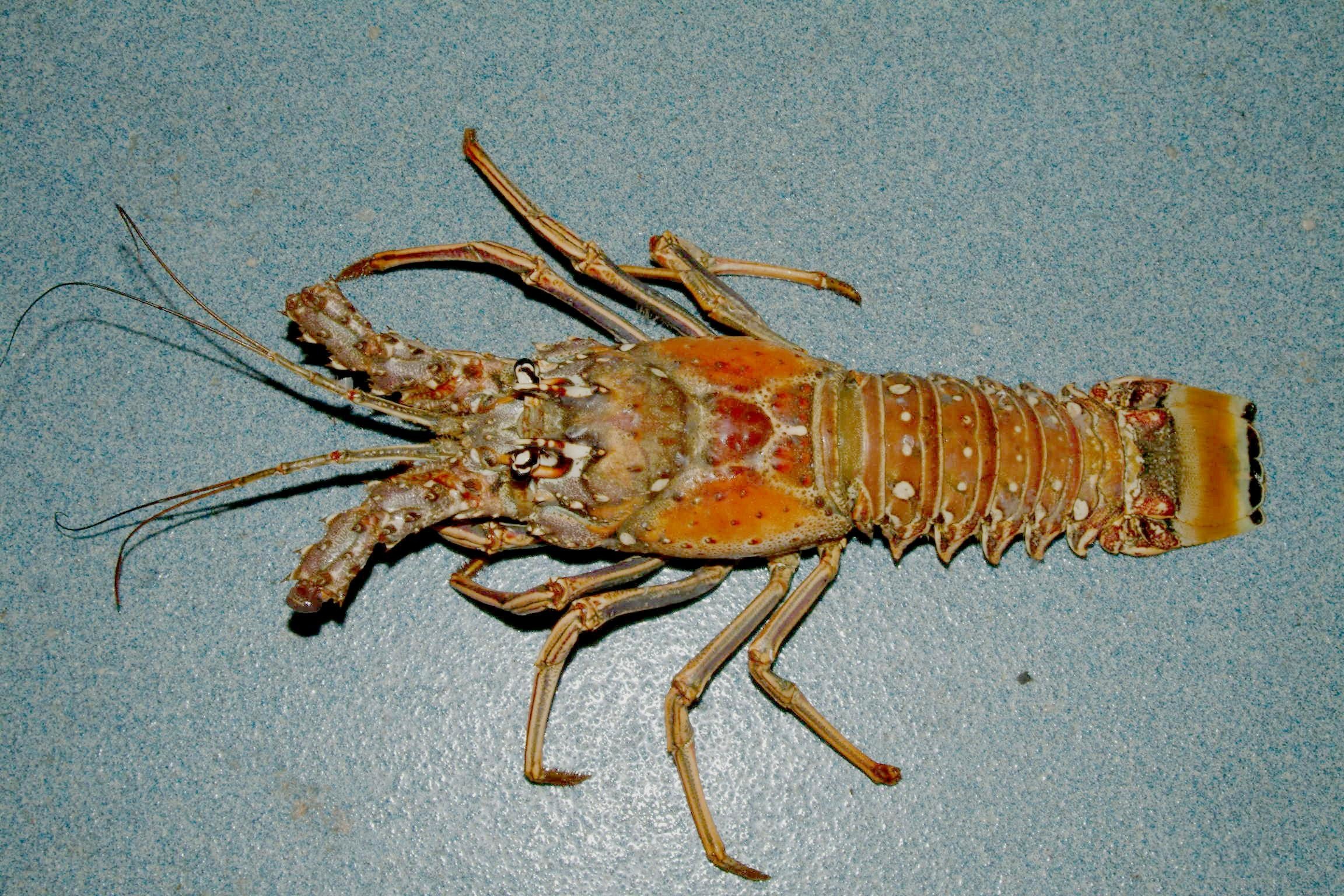
Long spiny antennae, no large front claws, and paired pale spots on the tail help distinguish this lobster. FAO describes four prominent yellow spots on the second and last abdominal segments.
Where to find it
Documented Caribbean areas are listed below with occurrence sources. Records may be historical and do not establish abundance.
Habitat
Sheltered reef, rocky and seagrass habitats; crevices provide daytime cover.
Depth
Usually shallow, but documented to about 90 m and potentially deeper.
Best season
NOAA describes year-round Caribbean spawning. Local closed seasons still apply and cannot be inferred from spawning or seafood-market availability.
Best time
Natural feeding activity is nocturnal. This is biology, not confirmation that night collection or diving is allowed.
Best tides
Information unavailable in the sources reviewed for this guide.
Best weather / conditions
Information unavailable in the sources reviewed for this guide.
Best bait
No hook-and-line recommendation is provided for this lobster.
Best artificial lures
No hook-and-line recommendation is provided for this lobster.
Tackle setup
Carry the measuring device required by the local rules. Do not assume a Florida carapace gauge or permitted device is valid in another territory.
Hook size
No hook-and-line recommendation is provided for this lobster.
Line
No hook-and-line recommendation is provided for this lobster.
Leader
No hook-and-line recommendation is provided for this lobster.
Fishing techniques
NOAA documents recreational collection while snorkeling or scuba diving. Commercial nets and traps are also documented, but their use is not automatically allowed for recreational fishers. Verify local methods before collecting.
Step-by-step: how to catch it
- Verify local collection rules, permitted gear and measurement requirements before entering the water.
- Identify the lobster without damaging its shelter.
- Leave any prohibited or uncertain animal in place; retain only when legality is established.
Typical size
FAO gives about 200 mm total length as usual. Total length is different from carapace length used in many regulations.
Maximum size
FAO reports 450 mm maximum total length. This is not a minimum legal size.
Edibility
Edibility is not established in the catalog; see the table-quality section.
Cleaning
Keep legally retained seafood chilled and separate raw seafood from ready-to-eat food. A species-specific cleaning procedure is not established here.
Cooking suggestions
Cooking idea: bake or grill legally obtained portions. Cook seafood to 145°F / 63°C; use a food thermometer.
Safety warnings
The carapace and antennae bear sharp spines. Avoid forcing hands into occupied crevices.
Regulations
Occurrence is not permission to fish or keep a catch. Check the area-specific status below, then verify current local seasons, sizes, gear, permits and marine protected areas before fishing. Unknown means unverified, not unrestricted.
Conservation
Protect shelters and nursery vegetation. Carrying eggs and spawning are biological facts; retention decisions require local legal verification.
Physical appearance
A hard, spiny carapace and powerful tail fan; body colors are variable and mottled.
Diet
Juveniles and adults eat snails, crabs and clams.
Behavior
Forages at night and shelters by day. Individuals can migrate together; FAO describes autumn single-file movements.
Fishing depth
Information unavailable in the sources reviewed for this guide.
Fishing environments
Coastal reefs, rocks and vegetated nursery habitat are relevant; not a freshwater species.
Table quality
NOAA describes the tail meat as firm, mildly flavored and sweet.
Catch and release
Leave uncertain, protected or prohibited catches in their habitat. Do not remove eggs to make an egg-bearing lobster appear harvestable. Check local rules before handling.
Documented Caribbean areas and local rules
- Puerto Rico — Unknown — pending verification
- U.S. Virgin Islands — Unknown — pending verification
- British Virgin Islands — Unknown — pending verification
- Anguilla — Unknown — pending verification
- Saint Martin — Unknown — pending verification
- Sint Maarten — Unknown — pending verification
- Saint Barthélemy — Unknown — pending verification
- Saba — Unknown — pending verification
- Sint Eustatius — Unknown — pending verification
- Saint Kitts and Nevis — Unknown — pending verification
- Antigua and Barbuda — Unknown — pending verification
- Guadeloupe — Unknown — pending verification
- Dominica — Unknown — pending verification
- Martinique — Unknown — pending verification
- Saint Lucia — Unknown — pending verification
- Saint Vincent and the Grenadines — Unknown — pending verification
- Barbados — Unknown — pending verification
- Grenada — Unknown — pending verification
- Trinidad and Tobago — Unknown — pending verification
- Aruba — Unknown — pending verification
- Curaçao — Unknown — pending verification
- Bonaire — Unknown — pending verification
- Bahamas — Unknown — pending verification
- Turks and Caicos Islands — Unknown — pending verification
- Cayman Islands — Regulated
- Jamaica — Unknown — pending verification
- Cuba — Unknown — pending verification
- Haiti — Unknown — pending verification
- Dominican Republic — Unknown — pending verification
Sources and field evidence
- Big Joe Caribbean catalog — individual occurrence and local rule sources retained
- FAO Western Central Atlantic, volume 1, PDF pages 329
- FDA — Selecting and serving seafood safely
- FWC — Spiny lobster (Florida harvest rules only)
- NOAA Fisheries — Caribbean spiny lobster
Other names: No synonyms recorded.