
Fish
Pacific barracuda
Barracuda del Pacífico
Sphyraena argentea
Guide by Captain Big Joe (Joe Arias)
At a glance
Most catches are smaller than the top size of about 4.8 ft (145 cm).
From the surface down to 59 ft (18 m).
Dawn and dusk are best; they also feed under working birds during the day.
1 area
Know it
Spot it, size it up and learn its habits.
- Identification
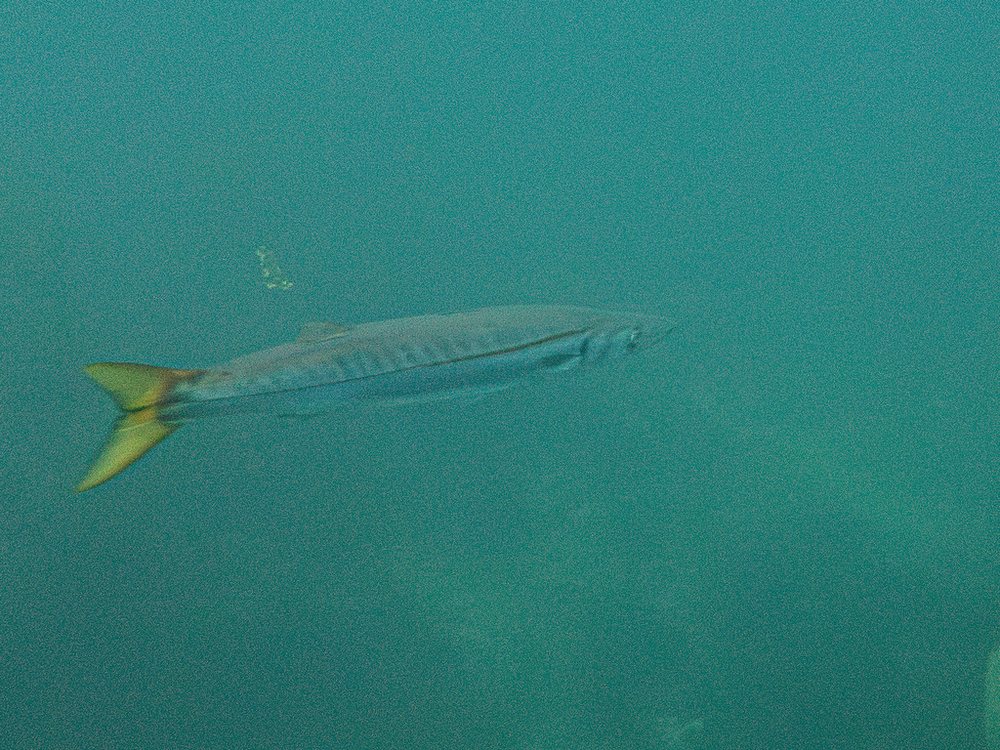
Long, thin, silvery fish with a pointed head, a jutting lower jaw full of sharp teeth and a yellowish forked tail. Much smaller than the great barracuda of the Caribbean.
- Typical size
Most catches are smaller than the top size of about 4.8 ft (145 cm).
- Maximum size
Up to about 4.8 ft (145 cm) long (fork length) and 26 lb (12 kg). Source: FishBase
- Diet
It feeds mainly on other fishes.
- Behavior
It usually stays near shore or near the surface, often in small schools, and moves south from California in autumn. It has large, sharp teeth and an aggressive nature.
Find it
Where, when and how deep to look.
- Where to find it
Found from Southern California.
- Habitat
Open water along the kelp, beaches and islands in spring and summer.
- Depth
From the surface down to 59 ft (18 m).
- Fishing depth
Surface to 100 ft; deeper on the banks in the middle of the day.
- Best season
Spring through fall, peaking in summer in warm-water years.
- Best time
Dawn and dusk are best; they also feed under working birds during the day.
- Best tides
Current and moving water over the banks and around the islands.
- Best weather / conditions
Warm, clear blue water and calm seas.
Bait & gear
What to tie on and what to throw.
- Best bait
Live anchovies and sardines.
- Best artificial lures
Chrome or blue-and-white irons, spoons and small swimbaits.
- Tackle setup
7–8 ft conventional rod with a strong star-drag or lever-drag reel.
- Hook size
1/0–4/0 live-bait hooks; surface and yo-yo iron jigs.
- Line
25–50 lb mono or 50–65 lb braid with a topshot.
- Leader
25–40 lb fluorocarbon.
BigJoe's setup for Pacific barracuda
The rod, reel, line and lures BigJoe would use.
As an Amazon Associate, BigJoe earns from qualifying purchases. It costs you nothing extra and helps keep this guide free.
Catch it
Step by step, from first cast to landing.
Step-by-step: how to catch it
- Go where it lives: Open water along the kelp, beaches and islands in spring and summer.
- Rig up: 7–8 ft conventional rod with a strong star-drag or lever-drag reel. 25–40 lb fluorocarbon.
- Pick your bait: Live anchovies and sardines. Lures: Chrome or blue-and-white irons, spoons and small swimbaits.
- Fish it: Cast and retrieve an iron fast through the schools, or fly-line a sardine. Use a long-shank hook or light wire because of the teeth.
- Time it: Dawn and dusk are best; they also feed under working birds during the day. Current and moving water over the banks and around the islands.
- Fishing techniques
Cast and retrieve an iron fast through the schools, or fly-line a sardine. Use a long-shank hook or light wire because of the teeth.
- BigJoe's tip
When the barracuda are thick, a fast-retrieved iron catches more than bait.
- Catch and release
Catch and release: wet your hands, keep the fish in the water when you can, and release it quickly. Use circle hooks and a dehooker.
Clean & cook
Is it good to eat, and how to prepare it.
- Edibility
Good eating when fresh.
- Cleaning
Bleed and ice it right away. Fillet, then remove the skin and any dark bloodline.
- Cooking suggestions
Soft, mild meat — best eaten fresh, grilled or smoked the same day.
Stay safe & legal
Safety, rules and taking care of the fishery.
- Safety warnings
Strong runs — keep fingers clear of the line and reel, and gaff carefully.
- Regulations
California has a 28 in minimum size. Check CDFW for current limits. Licenses, size and bag limits and seasons are set by each state — the California Department of Fish and Wildlife (wildlife.ca.gov), Oregon Department of Fish and Wildlife (myodfw.com) and Washington Department of Fish and Wildlife (wdfw.wa.gov) — together with NOAA Fisheries and the Pacific Fishery Management Council. Rules change often, and many areas are no-take marine reserves: check before you go.
- Conservation
Keep only what you'll eat, release the rest quickly, and follow size and bag limits.