
Sharks & Rays
Tiger shark
Tintorera
Galeocerdo cuvier
Guide by Captain Big Joe (Joe Arias)
At a glance
Most are around 16 ft (500 cm).
From the surface down to 2,625 ft (800 m), usually in the top 459 ft (140 m).
Dusk and night are prime.
23 areas
Know it
Spot it, size it up and learn its habits.
- Identification
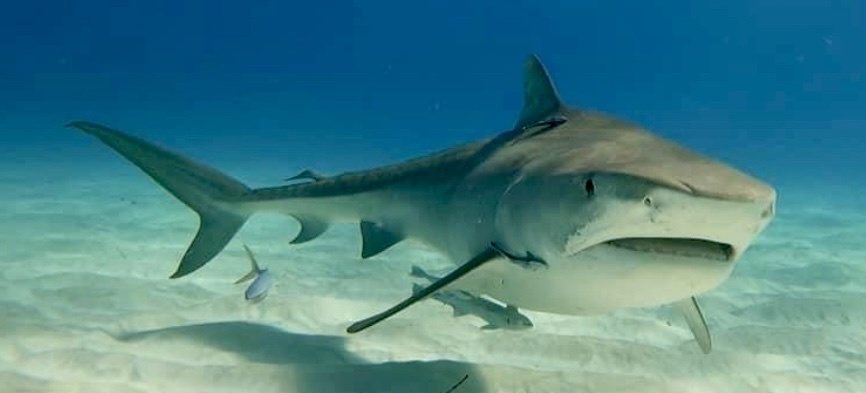
Big, blunt-nosed shark with dark vertical tiger stripes (fading with age) and serrated, cockscomb-shaped teeth.
- Typical size
Most are around 16 ft (500 cm).
- Maximum size
Up to about 25 ft (750 cm) long and 1,780 lb (807.4 kg). Source: FishBase
- Diet
It feeds at night on almost anything: other sharks, rays, fish, sea turtles, seabirds, marine mammals, squid and crustaceans. It even eats carrion and garbage like cans and metal.
- Behavior
It stays on or near coastal and island shelves, visiting estuaries, harbors, wharves, atolls and lagoons. It makes trips into open ocean but is not a true ocean wanderer.
Find it
Where, when and how deep to look.
- Where to find it
Found from South Florida & Keys, Florida Atlantic Coast, Florida Gulf Coast, Northern Gulf (AL–TX), Mexico Gulf Coast, Mexican Caribbean & Belize, Central America, Colombia & Venezuela, Bahamas & Turks and Caicos, Cuba, Jamaica & Cayman, Dominican Republic, Puerto Rico, Virgin Islands, Lesser Antilles, Aruba, Bonaire & Curaçao, Trinidad & Tobago, Georgia & South Carolina, North Carolina, Virginia & Chesapeake Bay, Delaware & New Jersey, New York, Long Island & Connecticut and Rhode Island & Massachusetts.
- Habitat
Reefs, passes, beaches and offshore; often comes shallow at night.
- Depth
From the surface down to 2,625 ft (800 m), usually in the top 459 ft (140 m).
- Fishing depth
From waist-deep surf to reef edges and channels.
- Best season
All year in South Florida; spring and summer are busiest along the Gulf.
- Best time
Dusk and night are prime.
- Best tides
Moving water in passes and along beaches.
- Best weather / conditions
Fishable in most conditions you can handle safely.
Bait & gear
What to tie on and what to throw.
- Best bait
Not to be targeted for harvest.
- Best artificial lures
—
- Tackle setup
Heavy spinning or conventional, 50–80 lb class.
- Hook size
10/0–16/0 non-stainless, non-offset circle hooks (required when shark fishing in Florida and federal waters with natural bait).
- Line
50–80 lb braid or mono.
- Leader
Wire or heavy cable leader longer than the shark.
BigJoe's setup for Tiger shark
The rod, reel, line and lures BigJoe would use.
As an Amazon Associate, BigJoe earns from qualifying purchases. It costs you nothing extra and helps keep this guide free.
Catch it
Step by step, from first cast to landing.
Step-by-step: how to catch it
- Go where it lives: Reefs, passes, beaches and offshore; often comes shallow at night.
- Rig up: Heavy spinning or conventional, 50–80 lb class. Wire or heavy cable leader longer than the shark.
- Pick your bait: Not to be targeted for harvest. Lures: —
- Fish it: Catch-and-release only from heavy tackle; never bring it aboard.
- Time it: Dusk and night are prime. Moving water in passes and along beaches.
- Fishing techniques
Catch-and-release only from heavy tackle; never bring it aboard.
- BigJoe's tip
If one shows up behind your boat while fishing, move — they will take your catch.
- Catch and release
Catch and release: wet your hands, keep the fish in the water when you can, and release it quickly. Use circle hooks and a dehooker.
Clean & cook
Is it good to eat, and how to prepare it.
- Edibility
Do not keep — protected.
- Cooking suggestions
Do not keep — protected.
Stay safe & legal
Safety, rules and taking care of the fishery.
- Safety warnings
Never pull a shark onto the sand by the tail or bring large sharks aboard. Cut the leader close to the hook if you can't remove it safely.
- Regulations
PROHIBITED in Florida state waters: tiger sharks may not be harvested and must stay in the water. A Florida fishing license is required unless you are exempt; Florida rules are set by FWC (myfwc.com). Federal waters fall under NOAA Fisheries. Other states and countries set their own limits — check before you keep fish.
- Conservation
Keep only what you'll eat, release the rest quickly, and follow size and bag limits.
Where it's found
Tap an area to open its fishing map.